> For the complete documentation index, see [llms.txt](https://help.security.gallagher.com/knowledge-hub/llms.txt). Markdown versions of documentation pages are available by appending `.md` to page URLs; this page is available as [Markdown](https://help.security.gallagher.com/knowledge-hub/command-centre-web-releases/2024/february.md).
# February
**Date Released:** 19/02/2024
### New Feature - Managing Card PINs
We are excited to announce the new card PIN functionality in Command Centre Web, which allows operators to view and set a card PIN number on cardholders.
To use this feature, operators will need to have the relevant privilege to view or set a PIN number, as they do in the Command Centre client. Operators can access the card PIN functionality by clicking on the relevant credential, in the credentials tab of the cardholder. If the credential is configured to use PINs, they will see the 'Two Factor Authentication' section in the panel that slides out. Here operators will be able to view the current PIN and assign a new PIN for the credential. Operators are also able to generate a random PIN number if needed.

Viewing the current PIN is as simple as clicking on the 'eye' icon, to unmask the PIN. Note: only system generated PINs can be viewed in Command Centre Web at this stage. If a cardholder has a custom PIN that was set manually or imported from another system, Command Centre Web will not display it.
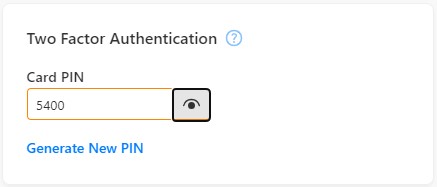 To set a new PIN, it can be manually inputted, by overwriting the current PIN. It will require the user to input the PIN twice before it can be saved, and the PIN is masked to ensure another cannot view what was entered. The 'Confirm PIN' field will appear once the user starts entering a new PIN.
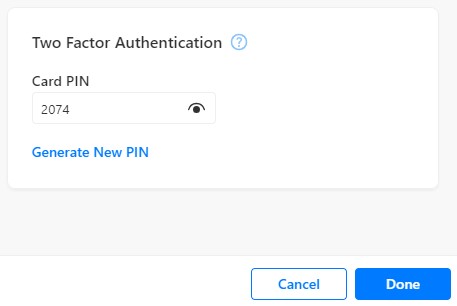
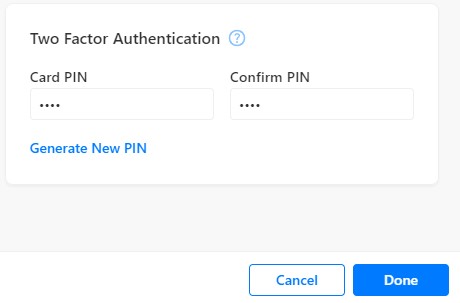 Alternatively, a random PIN can be generated by Command Centre Web, by selecting 'Generate New PIN'. This will generate a random number and display to the user. Note: this will only be displayed once. After saving, this will not be able to be viewed within Command Centre Web (can be viewed in the Command Centre desktop client.).
 This feature will be available in Command Centre Web for all sites running Command Centre v8.80+.
---
# Agent Instructions
This documentation is published with GitBook. GitBook is the documentation platform designed so that both humans and AI agents can read, navigate, and reason over technical content effectively. Learn more at gitbook.com.
## Querying This Documentation
If you need additional information that is not directly available in this page, you can query the documentation by asking a question.
Perform an HTTP GET request on the following URL with the `ask` and `goal` query parameters:
```
GET https://help.security.gallagher.com/knowledge-hub/command-centre-web-releases/2024/february.md?ask=&goal=
```
`ask` is the immediate question: it should be specific, self-contained, and written in natural language.
`goal` is what the user is ultimately trying to achieve, the reason they need the answer. Sharing it helps GitBook give you a better, more relevant answer. A goal is most helpful when it describes the outcome the user wants rather than restating the question. For example, with `ask=how do I create an API token`, a goal like `automate deployments from our CI pipeline` lets GitBook tailor the answer to that use case.
The response will contain a direct answer to the question and relevant excerpts and sources from the documentation.
Use this mechanism when the answer is not explicitly present in the current page, you need clarification or additional context, or you want to retrieve related documentation sections.
This feature will be available in Command Centre Web for all sites running Command Centre v8.80+.
---
# Agent Instructions
This documentation is published with GitBook. GitBook is the documentation platform designed so that both humans and AI agents can read, navigate, and reason over technical content effectively. Learn more at gitbook.com.
## Querying This Documentation
If you need additional information that is not directly available in this page, you can query the documentation by asking a question.
Perform an HTTP GET request on the following URL with the `ask` and `goal` query parameters:
```
GET https://help.security.gallagher.com/knowledge-hub/command-centre-web-releases/2024/february.md?ask=&goal=
```
`ask` is the immediate question: it should be specific, self-contained, and written in natural language.
`goal` is what the user is ultimately trying to achieve, the reason they need the answer. Sharing it helps GitBook give you a better, more relevant answer. A goal is most helpful when it describes the outcome the user wants rather than restating the question. For example, with `ask=how do I create an API token`, a goal like `automate deployments from our CI pipeline` lets GitBook tailor the answer to that use case.
The response will contain a direct answer to the question and relevant excerpts and sources from the documentation.
Use this mechanism when the answer is not explicitly present in the current page, you need clarification or additional context, or you want to retrieve related documentation sections.